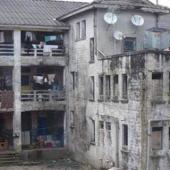
Displacement Fear Rises As Policemen, Families Face Eviction From Iponri Barracks In Lagos

According to multiple sources within the barracks who spoke with SaharaReporters, residents have been issued a directive to vacate their apartments by Friday and Saturday, the 24th and 25th of the month.
Tension is mounting within the Iponri Police Barracks, Lagos State, following reports of an imminent eviction order affecting hundreds of police officers and their families.
The development has sparked widespread concern over the welfare of security personnel and the broader implications for public safety in Lagos State.
According to multiple sources within the barracks who spoke with SaharaReporters, residents have been issued a directive to vacate their apartments by Friday and Saturday, the 24th and 25th of the month.
The short notice has left many scrambling to find alternative accommodation in a city already grappling with high housing costs and limited availability.
Authorities overseeing the relocation have reportedly proposed compensation packages of ₦2 million for officers living in two-bedroom apartments and ₦1 million for those in one-bedroom units.
However, affected officers argue that these amounts fall significantly short of what is required to secure comparable housing within Lagos.
Widely regarded as Nigeria’s commercial hub, Lagos is one of the most expensive cities in the country.
Rental costs in many parts of the city have surged in recent years, making it difficult for even middle-income earners to secure decent housing.
For police officers — many of whom rely on subsidised accommodation — the sudden transition into the private rental market presents a daunting challenge.
“This is not just about moving out,” one officer, who requested anonymity, said. “It’s about where we are expected to go within such a short time and with limited financial support.”
The situation at Iponri has drawn comparisons to previous demolitions of police barracks in areas such as Falomo and Obalende.
In those cases, officers were displaced under redevelopment initiatives that promised modern housing facilities.
Years later, however, many of those projects remain incomplete or entirely stalled. The lack of visible progress has fuelled skepticism among officers now facing eviction at Iponri, raising questions about whether history may be repeating itself.
Urban development analysts note that such patterns can erode trust between security personnel and authorities. “When redevelopment promises are not fulfilled, it creates long-term institutional distrust,” one expert observed. “That has consequences not just internally, but for the effectiveness of the entire policing system.”
Beyond housing concerns, the potential displacement carries serious implications for police morale and operational efficiency.
Officers dealing with housing instability may struggle to maintain focus on their duties, particularly in a high-pressure environment like Lagos.
Security experts warn that the issue could extend into broader public safety risks.
A police force preoccupied with personal welfare challenges is less equipped to respond effectively to crime and emergencies.
Additionally, the disruption threatens to dismantle established community policing structures. Over time, officers stationed in barracks like Iponri often build strong relationships with surrounding neighborhoods — connections that play a critical role in intelligence gathering and rapid response.
“Community trust doesn’t happen overnight,” another analyst explained. “When officers are abruptly relocated, those networks are broken, and rebuilding them takes time.”
Stakeholders are increasingly calling on authorities to adopt a more structured and humane approach to redevelopment projects involving security personnel.
Among the key recommendations being proposed are: phased redevelopment.
Experts suggested that demolition and reconstruction should occur in stages, allowing officers to remain housed while new units are built.
Also, it was said that financial support must align with current housing realities in Lagos. Alternatively, providing ready-to-occupy housing units may offer a more practical solution than cash payments.
While the issue may appear localized, analysts emphasise that its implications are national in scope. The welfare of security personnel is widely regarded as a cornerstone of effective policing and national stability.
Failure to adequately address the situation at Iponri could set a concerning precedent, potentially affecting morale across the police force and weakening public confidence in security institutions.
As the eviction deadline approaches, affected officers and their families remain in a state of uncertainty. For many, the coming days will determine not only their housing situation but also their ability to continue serving effectively.