EXCLUSIVE: Roof Collapses, Oyo Zonal Office Staff Work In Floodwaters As NITR DG Faces Fraud, Intimidation Allegations

Workers say the situation has become so dangerous that they fear the structure could collapse during a severe storm. Yet, according to insiders, funds meant for maintenance are allegedly diverted to new projects that they claim serve private interests rather than institutional needs.
The South-West Zonal Office of the Nigerian Institute for Trypanosomiasis and Onchocerciasis Research (NITR) in Ibadan, Oyo State, tells a story of decay that staff say mirrors deeper problems within the institution.
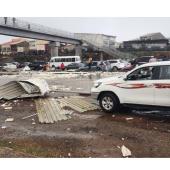
At the facility located at American Quarters, Yidi/Gate, the roof has collapsed, leaving the first floor exposed to weather elements. During heavy rainfall, water pours into the building, cascading down to the ground floor and flooding offices where employees are forced to work.
“During downpours, we sit inside water,” one staff member told SaharaReporters. “The legs of our tables and chairs are soaked and rotting. We step into floodwater inside our offices. It is very dehumanising.”
Workers say the situation has become so dangerous that they fear the structure could collapse during a severe storm. Yet, according to insiders, funds meant for maintenance are allegedly diverted to new projects that they claim serve private interests rather than institutional needs.
“The building could collapse on us any day,” another staff member said. “But instead of fixing what we have, the management prefers to start new projects where they can get cuts.”
These allegations form part of broader claims by employees that the institute, headquartered in Kaduna, has drifted from its core mandate of combating tsetse flies and trypanosomiasis in rural communities.
Staff Allege Culture of Fear and Intimidation
Multiple staff members who spoke to SaharaReporters on condition of anonymity cited fear of retaliation and victimisation. They accused Director General Dr. J. J. Ajakaiye of presiding over an environment where dissent is punished.
Some employees went further to allege that the DG employs intimidation tactics. According to insiders, his office at Pan African Tsetse and Trypanosomiasis Eradication Campaign-Nigeria (PATTEC-Nigeria) has allegedly been used to divert federal project funds. Staff claim supplies are delivered during the day and quietly returned to contractors at night, while payments are recycled through proxy accounts.
“The office functions like a personal lootbox,” one staff member alleged. “Money comes in from government projects, but large portions are diverted for private gain.”
Individuals mentioned by staff in connection with the matter include Mr. Usman Baba (Chairman ASURI), Ayodele Samuel, and Lifidi Joseph. Staff also referred to what they described as the “10 million naira saga” involving Mrs. Kehinde Okoh.
According to staff accounts, goods supplied by a contractor were transferred from central stores to PATTEC stores and later returned. They further claimed that funds associated with these transactions were routed through accounts linked to the DG.
Mrs. Okoh was reportedly requested to sign documents related to the arrangement but declined and raised her concerns during a management meeting.
“He turned the management team against her,” a source said. “Within a short time, she was forced out of PATTEC-Nigeria.”
Staff claimed that Dr. Abedo Alex was similarly removed within six months after disagreements with the DG. They also cited the case of Dr. Rolayo Emmanuel, whom they said initially received public praise but later clashed with management over financial issues.
A key dispute reportedly involved the Tsetse Fly Mass Rearing Project in Vom, Plateau State. According to staff, Dr. Emmanuel was asked to release project funds.
“When she refused, the DG moved the facility under his direct supervision,” one insider said. “He then forced her to pay funds into the personal account of the cashier, Bello Yakubu.”
Staff alleged she was later pressured to generate fake invoices and alter inventory records. When she refused, they said she faced queries and was transferred after submitting a petition to the ministry in October 2025.
“She submitted the petition, and on the same day, she was transferred,” a staff member claimed. “It was clearly meant to silence her.”
They further alleged that her posting to the Gombe Zonal Office amid security challenges in the North-East was intended to weaken her complaints before anti-corruption agencies.
Some staff members alleged the DG boasted of influencing officials in Abuja through employment slots and contracts. Others claimed that internal fellowship meetings initiated for moral support declined as workers became disillusioned.
“The boss’s behaviour contradicts the values the fellowship stood for,” one participant said. “Many people stopped attending.”
Insiders also alleged that personal relationships influenced management appointments and resource allocation.
Staff singled out several officials as alleged enablers of irregularities. They mentioned Ngozi Uzoka of the South-East Zonal Office, Enugu, who they said was summoned by the Economic and Financial Crimes Commission (EFCC) in 2025 alongside others, including the DG’s brother, Raphael Ajakaiye.
They also raised concerns about Dr. Mohammed Askirama, who was accused of benefiting from a disputed academic qualification; Dr. Bashir Aminu, who reportedly heads both the Human African Trypanosomiasis Research Department and the Molecular Laboratory; and Dr. Alice Jonah, Director of Linkages, whom staff alleged has a history of questionable contracts.
“The management is like an occult,” one employee alleged. “He decides who enters and who stays.”
Disputed PR Statement
Staff also dismissed a counter-publication issued by the institute’s Public Relations Unit after SaharaReporters previous exclusive report, defending the DG. They alleged that a female officer was pressured into releasing it.
“Do you expect them to admit to the allegations?” a staff member asked. “They are either co-looters or scared of victimisation.”
They cited procurement figures, including N5,411,714.72 for syringes and N6,538,236.52 for printer toner, questioning their necessity.
Infrastructure Decay Beyond Ibadan
Workers said the Ibadan office is not the only neglected facility. They alleged that liaison offices in Owo, Afikpo and Warake remain under-equipped, while new facilities are being initiated elsewhere.
“The DG is building new diagnostic laboratories when headquarters laboratories are filled with archaic equipment,” one staff member said.
They also claimed that basic infrastructure such as toilets remains poorly maintained.
Staff described the DG as projecting modesty through religious affiliation and lifestyle. However, they alleged he is constructing large mansions in Abuja and Ibadan.
“He pretends to be building, but he is destroying the institution from underneath,” a long-serving employee said.
Staff demanded the immediate suspension of the Director General and the entire management team, along with a forensic audit of the organisation’s finances from 2022 to date and the intervention of anti-corruption agencies.
“Only a thorough forensic investigation can expose the full extent of the financial damage,” one staff member said.
When SaharaReporters contacted members of the management team individually by telephone, they declined to comment.
Dr. Alice Jonah, Director of Linkages and head of the Suleja out-station, also declined to respond after listening to the reporter’s inquiry. She requested that a voice message be sent instead, stating, “How do I know that you are from SaharaReporters? There is nothing on my table to react to,” before ending the call.
Dr. Jonah was also accused by some staff of involvement in questionable contract practices, with claims said to date back to her tenure as head of the Vector and Parasitology Studies Department and her role in PATTEC-Nigeria. According to these staff accounts, she was alleged to have solicited funds from contractors.
Dr. Bashir Aminu, who is reportedly overseeing both the Human African Trypanosomiasis Research Department and the Molecular Laboratory, was also contacted by telephone. In response, he stated, “Sorry, my name is not among those being accused for any wrong thing in the Institute.”
Dr. Muhammad Askirama Abdullahi, who heads the Animal African Trypanosomiasis Research Department, did not respond to calls or a text message seeking his comment.
Some staff also questioned his appointment, alleging that he was promoted ahead of more senior colleagues.
They further claimed that the promotion was based on a six-month part-time MSc certificate obtained from institutions in West Africa whose qualifications are not recognised by the Nigerian government for civil service purposes.
When contacted earlier, Dr. Ajakaiye declined to address allegations against him directly over the phone.
“What I can tell you is that I run a transparent and open policy in government at NITR,” he said. “However, I cannot be bantering words over the air like this. It is not wise. If it is possible, you people can come down to NITR… When you come, you will meet me, the union, and the management, and we will get things right.”
He added that civil service rules limited his public comments.
Efforts to reach the Minister of Science, Innovation and Technology, Mr. Kingsley Udeh (SAN), were unsuccessful as he did not respond to calls or text messages at the time of filing this report.