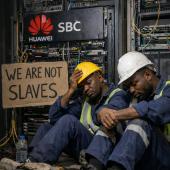
EXCLUSIVE: Nigerian Telecom Engineers Under Huawei SBC Cry Out Over “Slave-Like Conditions”, N140,000 Salary

The engineers lamented that despite playing critical roles in ensuring telecommunications services remain available nationwide, their welfare structure has not improved significantly for more than a decade.
Telecommunications engineers under the umbrella of the Private Telecommunications and Communications Senior Staff Association of Nigeria (PTECSSAN) have expressed concerns over alleged poor welfare, unsafe working conditions, low salaries, and inadequate health insurance while working under Huawei SBC operations in Nigeria.
Multiple sources who spoke with SaharaReporters described a troubling pattern of neglect, excessive workload, and systemic disregard for the well-being of engineers responsible for maintaining telecommunications infrastructure across the country.
According to the aggrieved engineers, many of whom work across major network providers including MTN and Airtel through intermediary arrangements coordinated by Huawei SBC, the working conditions have become increasingly unbearable, with little or no meaningful improvement in welfare packages over the years.
The engineers lamented that despite playing critical roles in ensuring telecommunications services remain available nationwide, their welfare structure has not improved significantly for more than a decade.
Sources told SaharaReporters that some engineers receive as little as N1,000 in HMO-related coverage benefits monthly, a situation they described as grossly inadequate considering the hazardous nature of their work.
One affected engineer described the overwhelming workload and poor salary structure, stating that he currently manages over 200 telecom sites alongside only two Field Maintenance Engineers (FMEs), leaving him overworked and financially strained.
“I am a regular worker and let me show you, I cover over 200 sites. I work with two FMEs. So the workload is too much and the salary is nothing to write about,” the engineer said.
“So I receive N140,000 per month and from there we buy most of our PPE (Personal Protective Equipment). My HMO is nothing to write about.
“Just last month I took my woman to the hospital. Getting there, they said we were entitled to N100,000 for the antenatal.
“So I reached out to my HR. My HR said if it is what the hospital said, then that is it. So there is nothing to write home about.
“After they have treated my woman, they now paid the N100,000. Out of the N100,000, I still paid the balance of almost N317,000 in the hospital while I have HMO. I went there in respect of my HMO.
“When getting there, I spent more than even the HMO. So now I don’t even know. So things are very hard.
“I don’t even have much cash. So the small salary they pay now, I use it to settle my debt. I borrowed from people I borrowed the money from.
“So things are not easy.”
Another engineer narrated a life-threatening workplace incident which he said nearly resulted in permanent disability after attempting to install a heavy Remote Radio Unit (RRU) without adequate support equipment or manpower.
According to him, the physical demands of the task left him with severe leg injury complications and long-term health concerns.
“I faced a lot last year, but I thank God that I’m still alive today,” he said.
“Because what happened to me last year, I didn’t expect that I would still be on this system. Engineers are suffering, to be sincere. In this telecom, engineers are suffering.
“Late last year, I almost lost my leg. I was on the site, working with an FME, something that I’ve never done before, to fix just one RRU. I used almost three hours trying to position the RRU, because the way to position it is not fine at all.
“So, doing that, struggling with it, and it was very heavy. I found a way, positioning myself, doing all that. So before I could be able to do it, one part of my leg was almost dead, because I was carrying it on my leg, trying to use my leg for support.
“So I managed, I succeeded to fix it. I came down and I couldn’t walk.”
“Coming down from the tower itself was so difficult. But I thank God I came down, and I told the FME that my leg was dead. So I managed to go home, and I took drugs, pain relief,” he added.
“That is where I started developing pain on that leg, and it has lasted months. I’m trying to manage it but there’s no way. Now, the pain is worse.
“All the FME, the people I’m working with, they are telling me that I should go and take care of myself. I said, what will I do? Because HMO is zero.
“The last time I went to the HMO, they gave me a drug for BP (blood pressure) of N1,000, and they said after taking the drug I should return it because I was not entitled to it.
“I said, send me your account details, let me transfer the money. They did not answer me. I had to go and buy the drug myself.
“Later, doctors at the general hospital said I was almost developing a partial stroke. I spent roughly N350,000 treating myself in November and December.
“I don’t know if I still believe in the rubbish HMO they are giving us.”
According to PTECSSAN representatives, attempts by engineers to organise collectively and advocate for improved working conditions have reportedly been obstructed through bureaucratic bottlenecks allegedly imposed by intermediary firms involved in telecom infrastructure management.
The association stressed that Huawei’s role as both mediator and employer in relation to engineers working on telecommunications masts places the company in a strategic position to address pressing welfare issues affecting workers.
The engineers outlined a list of demands they believe are necessary to guarantee safe and dignified working conditions in the sector.
These demands include fair welfare packages covering HMO, pension, and salary review; provision of operational vehicles to ensure safe field operations; adequate personal protective equipment (PPE); reduced workload through increased workforce; payment for overtime duties; respect and fair treatment of engineers; and full compliance with health and safety standards.
Other demands include one-month annual paid leave, structured training programmes for engineers and riggers, provision of at least one rigger per engineer for field assignments, improved security arrangements for late-night emergency call-outs, comprehensive insurance coverage, provision of essential work tools such as laptops and technical equipment, abolition of the “no work, no salary” policy, introduction of mortgage housing schemes for engineers, and payment of a 13th month salary.
The association further highlighted safety concerns within the sector, noting that some engineers have allegedly lost their lives in the course of duty without compensation or insurance support for their families.
According to the group, colleagues often contribute personal funds to support bereaved families, with contributions sometimes not exceeding N200,000.
The association also cited a recent incident in the Omuaran area of Kwara State where an engineer was reportedly kidnapped alongside two others who were later confirmed dead, with the released victim’s family allegedly paying ransom to secure his freedom.
PTECSSAN noted that underlying health challenges among engineers, including hypertension and stress-related conditions, are increasingly common due to demanding work schedules and insufficient rest periods.
The union expressed concern that some engineers have reportedly worked for over 10 years with pension balances below N200,000, raising fears about long-term financial security after retirement.
The group further alleged that salary structures for field engineers have remained largely unchanged for years, with some engineers reportedly earning approximately N200,000 monthly since as far back as 2013 and 2014.
The engineers also complained about the discontinuation of operational vehicles previously assigned to support field activities, stating that workers are now required to use personal vehicles while receiving N480,000 annually as “self-rental” allowance, which they say is insufficient to cover fuel, maintenance, and operational costs.
According to the association, some engineers currently manage between 80 and 200 telecom sites simultaneously, significantly exceeding recommended workload levels and limiting adequate rest periods.
The issue of annual leave has also reportedly become a major concern, as some engineers claim they have not taken leave for more than five years due to staffing shortages and the requirement to find replacements before leave requests are approved.
PTECSSAN reiterated its commitment to protecting the dignity, welfare, and rights of workers in Nigeria’s telecommunications sector, stating that the public deserves to know the realities faced by engineers responsible for maintaining critical national communications infrastructure.
“It is long overdue, the world needs to know the conditions of the engineers that work tirelessly under Huawei SBC to ensure that service is available and usable at all times in Nigeria,” the association stated.
The union has called for urgent intervention from relevant stakeholders, urging authorities, labour organisations, and the public to pay closer attention to the welfare conditions of field engineers who play essential roles in sustaining telecommunications services nationwide.
Efforts by SaharaReporters to obtain an official response from Chukwudi Mobodo, GM, Fibre Operations, Huawei MS, at Huawei Technologies Nigeria Limited, concerning the allegations were unsuccessful, as he neither answered his calls nor replied to messages sent to him.